Tuesday, December 30, 2025

"Mitchell Johnson: Seeing Paintings Instead of Locations" Published July, 1997 in American Artist Magazine by Susana Byers

 Seeing Paintings Instead of Locations 

By Susana Byers

Published July 1997 in American Artist Magazine


   For Mitchell Johnson, painting outdoors in a variety of environments is a demanding but often rewarding way to create a body of work and improve his skills. The artist began painting outside while studying with Paul Resika and Leland Bell at Parsons School of Design in New York City, where he earned his M.F.A. degree in 1990. "We took landscape-painting trips to western New Jersey, and I clearly remember being completely discouraged by the fleeting nature of the light," he recalls.

"Painting outdoors forced me to work faster and more efficiently, and I felt challenged by the urgency of seizing an ephemeral moment. It's something you just don't experience in a studio.”

   He was also overwhelmed by the landscape itself. He says it took him a while to learn to see pantings instead of locations. "Don't make your painting about what you think a place looks like," he advises. "Make it

about the forms you have never seen before and have immediately fallen in love with.” Resika always said. 'Don't paint what you don't love.'

   In arranging a composition, Johnson usually fixes on one element in the scene that intrigues him, such as a field, a tree, or a house, and builds the painting around it. Then, peering through a frame he makes with his fingers, he finds the lights and darks and tries to imagine how they will play against patches of middle-value color. After that, using large, disposable house-painting brushes, he begins his picture by establishing what he calls a "big light"-a value foundation made up of two or three major fields of color. He then switches to bristle brushes and tiny sables to work out the details, whether a cypress tree or a sharp streak of light.

   "Every element in a painting must work in terms of composition and color," Johnson says. "My somewhat abstract interpretations of the landscape and people in outdoor scenes are the result of this belief; the painting has to function as a painting. For instance, when I depict a tree against a sky, there has to be both value and color tension between the two elements. I focus on color, texture, and placement as much as image. If one of these aspects, even in a single tree, doesn’t work, I’ll scrape off the paint and start over again-just as quickly as if the entire view had failed to come together.”

   The abstract underpinning of Johnson’s work is noticeable in his use of color. A bright orange streak across a cloud-dotted blue sky or a glowing speck of white at the base of a dark forest calls attention to itself in a startling manner yet also brings viewers’ eyes into the composition as a whole. Johnson’s color treatment expands the effect of his paintings, giving them a depth that goes beyond ordinary realism.

   The artist works on rough, absorbent, single-primed linen canvas with a range of brushes and uses both store-bought and homemade oil paints. He prefers linseed oil for a medium rather than turpentine because, he says, it produces a tough, durable surface for the paint instead of drying flat with little adhesion strength. He paints on location with a French easel and uses small palette knives to blend his paints. “When I’m tired from working in the sun, I’ll take a break in a shady spot, where I’ll mix dozens of colors,” he say. “By mixing paints on-site, I can get more accurate hues.”

   Johnson is passionate about painting en-plein-air because he believes it forces him to grow as a painter. “Every time I paint outside, I learn something new-especially about color and value,” he says. My paintings improved substantially when I realized that even though the color looked right on my palette, it would not necessarily sit right on the canvas. Color is always a function of its relationship to other colors. I remember when I first painted in Tuscany in Italy, the yellow wheat fields drove me crazy because the yellow paint always looked too dark against the white canvas. But once I placed other colors alongside the yellow, I was able to tune its value to what I was seeing.

   Johnson adds that he finds the constantly changing light very exciting. “Often, while painting a landscape, he notes, “a different light passes over the scene and I see something more interesting than what had enticed me to paint it in the first place. I then find myself altering the entire canvas to capture the change." Since the artist travels extensively looking for special light and color effects, he won't hesitate to completely rework a painting if

the unexpected occurs.

   Johnson took his first painting trip to France--to a small town in Provence -while still a student at Parsons. He was struck by the light and scenery there, but when he began painting, he quickly became frustrated because he was unable to capture the colors. "The local people who saw my early work criticized me for making the paintings too dark and pointed out that I wasn't catching the sharp, southern light," he recalls.

   Determined to paint the landscape, Johnson spent long, exhausting days in the sun on that trip and returned the following year, when he began to feel comfortable depicting the area. "I was finally able to let go and allow the place to teach me to paint it," he explains. "The weather, the richness of the terrain, and even my interactions with the people all affected what I was creating. I think the more familiar I became with the place, the freer I was to express myself.”

   Ever since those first trips to France, Johnson has continued to travel and paint generally, for three to six months a year. In addition to an annual excursion to Provence, he also spends considerable time in Tuscany and New Mexico. “I've grown to prefer dry, sun-drenched landscapes, and these three regions provide that, each with its own subtleties," he explains.

"It's amazing that I could be driving in New Mexico and come upon a field that is the same gray color I remember from Tuscany. Or I can go home to Palo Alto and see the type of sky I saw in Provence. Some times by looking at a scene near my home, I'm able to complete a painting I started in Italy or France.”

   Because he generally paints in the same locations while traveling abroad, Johnson stores easels and paints in each country to reduce the amount of equipment he must transport. All he comes home with are the paintings, which have been removed from their stretchers and are re-stretched later. Johnson suggests to anyone who wants to paint outdoors away from home to put together a list of the equipment and materials needed to make sure nothing is forgotten and to practice setting up outside as a double check. He also advises, “Don’t forget to bring a good hat and sunblock, keep your painting in the shade while you’re working on it so that it will look good in any light, and bring along a canvas bag you can fill with rocks or water bottles to ballast your easel.”

   The son of an army chaplain, Johnson became adjusted to traveling at an early age because his father had to relocate often. He also enjoys it. “When I move around, certain unexpected situations or problems arise that add to the creative experience,” he says. “I don’t fall into a routine the way I do when I’m at home, and each day becomes more profound. My paintings are born of uncertainty and adventure. The ones I do of Tuscany, for instance, are as much about what is happening to me at the time as about the province’s yellow hills.”

   Johnson, who holds a B.S. degree from Randolph-Macon College in Ashland, Virginia, and an M.F.A from Parsons School of Design in New York City, is represented by Hackett-Freedman in San Francisco, Tatistcheff/Rogers in Santa Monica, California, Robischon Gallery in Denver and Mitchell, Brown Fine Art in Santa Fe.


Susana Byers is a freelance writer and producer in the film and television industries. She lives in New York City.


Thursday, November 13, 2025

Friday, August 22, 2025

Mitchell Johnson Exhibition, "Twenty Years in Truro (Selected Paintings 1989-2025)


"Six Pickets (hydrangeas)," 2025, 24x30 inches, oil/canvas. (© Mitchell Johnson)

Truro Center for the Arts at Castle Hill in Massachusetts presents Twenty Years in Truro (Selected Paintings 1989-2025), a solo exhibition of paintings by San Francisco Bay Area artist Mitchell Johnson, on view September 3–14, 2025. This is Johnson’s fifth exhibition at Castle Hill, where he teaches a master color class every September.

There have been three watershed moments in Mitchell Johnson’s 45-year painting career: the first, a work trip to France in 1989, the second, his move from New York City to Palo Alto, California in 1990, and the third, an initial painting trip to Cape Cod in 2005. In his own words:

“I followed a very strong hunch that what I needed in 1989 was to leave graduate school and paint alone in France. It was all my idea, all my doing. In 1990, I was offered a chance to work in the studio of Sam Francis in Palo Alto, California. I didn’t want to leave NYC. I called Sol LeWitt on the phone, hoping he would say that I could join the Wall Drawing Team and stay in NYC. Instead he convinced me that I should move to California. In 2005, the art dealer Sally Munson invited me to visit Chatham, MA, to produce local work for a show she was curating of my European landscapes. My first paintings of Truro, paintings which changed my trajectory, were made because of Sally. Life, especially life in the art world, is an interesting combination of the things you pursue and the things that come your way. California fell into my lap. Truro fell into my lap.”

Johnson’s 20 years of annual painting trips to Cape Cod started in May 2005, immediately after he saw the historic Giorgio Morandi and Josef Albers exhibit in Bologna, Italy. He arrived on the Cape at a pivotal moment when his paintings were becoming less brushy, less impressionistic, more about large areas of flat color using familiar, even iconic, motifs to comment on color relativity. The range of work on view in the 2025 survey at Castle Hill illustrates the importance of this first stay on the Cape, examining the impact of North Truro motifs on all of his paintings. It features early Truro works borrowed from the Cape Cod Museum of Art, including “Truro n. 6” (2005), which appeared in two feature films by Nancy Meyers: The Holiday (2009) and Crazy Stupid Love (2011). The show also includes paintings from New York, Europe, California, New England, and Newfoundland.

Art critic Donald Kuspit reviewed Johnson’s paintings three times, including in a 2023 Whitehot Magazine article:

“Johnson is a master of abstraction, as his oddly constructivist paintings show, but of unconscious feeling, for his geometry serves to contain and with that control the strong feelings implicit in his strong colors. Apart from that, his paintings are art historically important, because they seamlessly fuse abstraction and realism, which Kandinsky tore apart to the detriment of both even as he recognized that they were implicitly inseparable, tied together in a Gordian knot, as they masterfully are in Johnson’s paintings.”

About the Artist

Mitchell Johnson began painting in the late 1970s as a teenager at Staten Island Academy. He received his MFA from Parsons School of Design in 1990 and also studied painting, drawing, and art history at the Washington Studio School and Randolph-Macon College. His paintings are in the permanent collections of over 35 museums. He has appeared on TV programs in France (BFM Nice), Italy (Generazione Bellezza), and Monaco (Monaco InfoTV). He has been a visiting artist at the Josef and Anni Albers Foundation, the American Academy in Rome, Borgo Finocchieto, and the LeWitt House in Praiano, Italy.

About the Exhibition

Twenty Years in Truro (Selected Paintings 1989-2025) is on view September 3–14 at the Truro Center for the Arts at Castle Hill in Cape Cod, Massachusetts.

  • Artist Reception: Thursday, September 4, 4–6pm (ET)
  • Artist Talk: Friday, September 5, 3:00–3:30pm (ET)

For more information, visit mitchelljohnson.com and follow him on Instagram at @mitchell_johnson_artist.

Additionally, Johnson’s exhibition of Paris paintings at Flea Street in Menlo Park, California, has been extended through September 18, 2025.

Tuesday, July 29, 2025

Mitchell Johnson Bakersfield Museum of Art review in Art Ltd magazine June, 2015

This is a review in Art Ltd magazine written by art historian, Rebecca Weller, in 2015 during my retrospective at the Bakersfield Museum of Art in California. 

Initially ignoring the fact that the gallery is filled with a mixture of abstract and representational paintings, Mitchell Johnson's work evokes an orchestra or color. The spectator's experience automatically (if unknowingly) mimics the artist's working process, which is to engage with multiple paintings at once--the jade green of a shadowed awn in one canvas reappears in an adjacent nonrepresentational one. While the landscapes evidence his time spent in Europe as well as in San Francisco (where he moved in 1990), they are snapshots of the artist's experience of these sites and not necessarily ours.


The painterly Pop quality of his work may be reminiscent of the Bay Area Figurative Movement, but as the title of the exhibit suggests, Johnson is all about color theory. Most of the abstract paintings are impressively large, consisting of horizontal and vertical rectangles (usually parallel to the canvas edges) as well as the occasional homage to the loser Albers square.


Each canvas obeys its own system. While a color may be repeated, neighboring hues will either intensify or mute it, reminding the viewer of the relativity of color. Of the large non-representational works. Biscuit (2009-2012) offers the brightest hues; yet, rather than competing with one another, the colors assert themselves one at a time, like parts of a symphony. Sometimes layered, but never simulating spatial depth, a few quadrilaterals are literally textured (evincing Johnson's tendency to use a palette knife) while others are just optically so. For example, a translucent white over a red shave does nor exclusively appear as layered, but rather, as a textured white surface. Both colors co-exist on the surface, rather than subordinating one to the other.


That Johnson is truly a formalist is remarkably evident in his approach to landscape and figurative works. In North Truro (Whiteline), 2008, there are multiple houses receding towards a horizon, but once again, it seems subservient to his use of color as form. The sun-drenched green lawn, thrusts itself forward to compete with the blue rectangle on the left as if sharing the same plane. There is a constant shift of perspective within the scene, mirroring our shift between viewing the painting as representational and then as abstract. Johnson seems far more concerned with the sincerity of painting as painting which Is always already a fictive space.


-REBECCA WELLER

Wednesday, July 2, 2025

Friday, April 4, 2025

Mitchell Johnson Paintings in the April 7 issue of The New Yorker and the April 6 New York Times Magazine


Inside Front Cover of April 7, 2025 New Yorker Magazine

Across from The Ethicist in April 6, 2025 NY Times Magazine

Mitchell Johnson (b. 1964, Rock Hill, South Carolina) is an American painter known for his vibrant, color-centric works that test the boundaries between abstraction and representation. His paintings are rooted in a deep investigation of color relationships, shape, and spatial perception, often drawn from his experiences in locations such as California, New England, Europe and Newfoundland.

Education and Early Career

Johnson studied painting and drawing at Randolph-Macon College (B.S., 1986) with Ray Berry, then studied art history, painting and drawing at the Washington Studio School and Parsons School of Design (M.F.A., 1990), where he learned from legendary teachers Leland Bell, Paul Resika, Robert De Niro, Sr., Larry Rivers, Jane Freilicher and Nell Blaine. In 1990, he moved to California to work as a studio assistant for painter Sam Francis, an experience that helped shape his mature approach to color and scale. He also studied with Wolf Kahn In Santa Fe, further deepening his sensitivity to color, scale and atmosphere.

Artistic Style and Philosophy

Art historian Peter Selz described Johnson as “an artist who makes realist paintings that are basically abstract paintings and abstract paintings that are figurative.” Johnson himself has noted, “I don’t paint chairs; I turn chairs into paintings,”encapsulating his approach to transforming the familiar through color, composition, and formal rigor.

His work often features distilled scenes—urban landscapes, architecture, coastlines—rendered with a painterly touch and bold, simplified blocks of color. This gives his paintings a formal structure while maintaining emotional resonance and a sense of place.

Critical Reception

Johnson’s work has been the subject of three major essays by renowned art critic Donald Kuspit, published in Whitehot Magazine. Kuspit writes that Johnson's paintings “demonstrate that realism can serve abstraction, and abstraction can serve realism,” praising his ability to bridge both traditions in a way that is highly original and formally inventive. Kuspit considers Johnson a unique voice in contemporary American art for his “realistic abstraction.”

Exhibitions and Collections

Johnson's work is held in over 35 museum collections and has been featured in solo exhibitions across the United States and Europe. Highlights include:

  • A 2024 retrospective at Musée Villa les Camélias in Cap d’Ail, France.

  • “Giant Paintings from New England, California and Newfoundland” at 425 Market Street, San Francisco (March–May 2025).

  • Group Show Glass House, New Canaan, Ct in June.

  • Numerous exhibitions at Truro Center for the Arts.

Public Exposure and Media

Johnson's work has also reached wider audiences through popular media:

  • His paintings have appeared in major feature films, including The Holiday (2006), It’s Complicated (2009), and Crazy, Stupid, Love (2011), helping to familiarize viewers with his distinct visual language.

  • He has participated in several television interviews in Italy, France, and Monaco, including a 2024 appearance on BFM Nice discussing his Cap d’Ail retrospective and an interview on Monaco Info.

  • In 2024, he appeared on the national Italian television program Generazione Bellezza during a special segment filmed at the Lewitt House in Praiano on the Amalfi Coast, highlighting his work in the broader context of artistic and cultural heritage.

Teaching

Once a year, Johnson teaches a master color class at Truro Center for the Arts.

Artistic Evolution and Independent Ventures:

After 25 years within the traditional gallery system, exhibiting in major galleries across San Francisco, New York, Santa Fe, and Los Angeles, Johnson embarked on an independent path in 2012. He initiated partnerships with prominent publications such as The New York Times Magazine, ArtForum, The Wall Street Journal Magazine, and The New Yorker.This strategic move expanded his audience, allowing his paintings to reach readers nationwide and internationally. 

Blog

Johnson writes weekly about color theory, art history and the art world on Substack.

Personal Life

Johnson lives and works in Menlo Park, California, with his wife, author Donia Bijan. His studio remains a space of continuous experimentation and refinement, as he pursues new formal challenges and explores the emotional resonance of color and place.

Saturday, March 29, 2025

Mitchell Johnson Paris Painting, Fifteen Windows, in the March 30, 2025 New York Times Magazine

Advertisement for the exhibition of Giant Paintings in San Francisco
 in the March 30, 2025 New York Times Magazine, page 15, across from The Ethicist.
 

Mitchell Johnson is exhibiting seven large-scale paintings in the lobby of the San Francisco skyscraper 425 Market Street from March 17 to May 30. Works include “Trinity East (Iceberg)” (2020–2024), 78×120 inches, made after a 2018 trip to Newfoundland, as well as three paintings of Johnson’s ongoing muse, the Presidio Park, with its peculiar, still-life-like collection of buildings. Seven sets of note cards accompany the exhibition and are for sale at Amazon and SFMOMA as well as other museums and bookstores.
The exhibition has been reviewed by Donald Kuspit in Whitehot Magazine in March, 2025.
Here is an excerpt of the Kuspit essay:
“Morandi and Albers are Johnson’s role models or mentors.  To my mind’s eye they are phenomenologists par excellence, which is what Johnson is at his best—as in these paintings–aspires to be, however unwittingly.  According to the philosopher Merleau-Ponty, in the Phenomenology of Perception, “Phenomenology is a transcendental philosophy which places in abeyance the assertions arising out of the natural attitude, but it is also a philosophy for which the world is ‘already there.’  It is painstaking…in its attentiveness and wonder, its demand for awareness.”  As the philosopher John Cogan writes, in The Phenomenological Reduction, “There is an experience in which it is possible for us to come to the world with no knowledge or preconceptions in hand; it is the experience of astonishment…in the experience of astonishment, our everyday ‘knowing,’ when compared to the knowing that we experience in astonishment, is shown up as a pale epistemological imposter.”  At their best, when they [Johnson’s paintings] have a kind of parsimonious aesthetic intensity and nuanced exactitude, and no longer register as the “belief-performance of our customary life in the world,” they are astonishing masterpieces of phenomenological perception, fraught with what the philosopher George Santayana calls “hushed reverberations.”

Johnson's paintings are in the permanent collections of over 35 museums as well as 700 private collections. His work has appeared in many feature films, most notably, Nancy Meyers films, The Holiday and It's Complicated. Seven paintings were also included in Crazy, Stupid, Love. Johnson's work is widely known because it has appeared in the New York Times Magazine over 200 times going back to 2012. Johnson has appeared on BFM Nice television in France and RAI 3 national television in Italy.

Wednesday, March 26, 2025

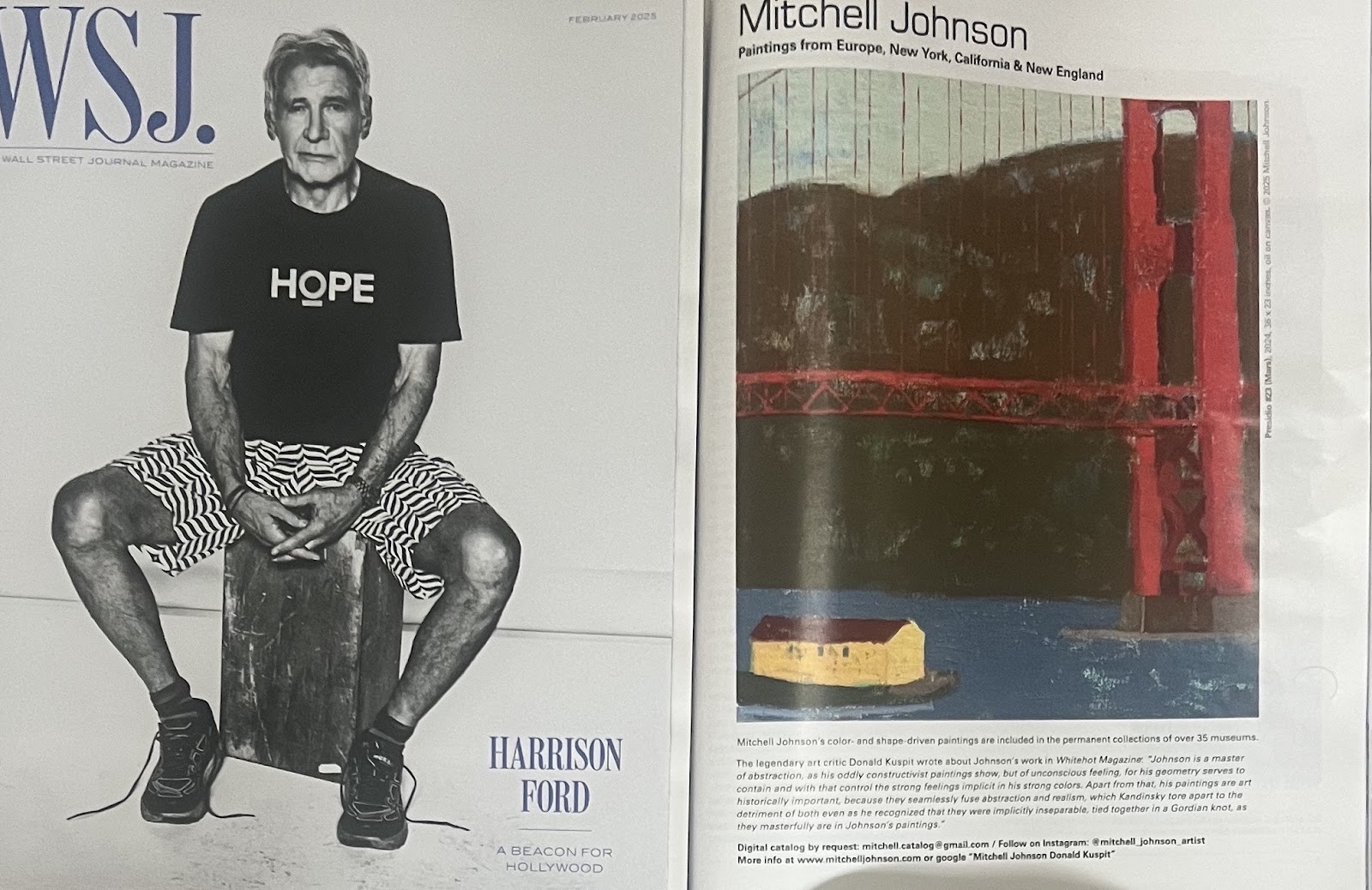
Mitchell Johnson Paintings in the 2025 WSJ Magazine


Mitchell Johnson "Giant Race Point Chair" painting in the March 2025 WSJ Magazine


Mitchell Johnson "Presidio #30" painting in the February 2025 WSJ Magazine

Mitchell Johnson is exhibiting seven large-scale paintings in the lobby of the San Francisco skyscraper 425 Market Street from March 17 to May 30. Works include “Trinity East (Iceberg)” (2020–2024), 78×120 inches, made after a 2018 trip to Newfoundland, as well as three paintings of Johnson’s ongoing muse, the Presidio Park, with its peculiar, still-life-like collection of buildings.

Read more about the exhibition in these articles in Hyperallergic, Whitehot Magazine and InMenlo.

Seven note card sets accompany the San Francisco exhibition and are available at Amazon, SFMOMA, Keplers Books, Explore Booksellers in Aspen and PAAM in Proincetown.

Friday, January 17, 2025

Mitchell Johnson Paintings in The New York Times Magazine January 5 and 19, 2025


Mitchell Johnson Positano Painting appears across from The Ethicist, Jan 19, 2025.

Mitchell Johnson Newfoundland Painting appears across from The Ethicist, Jan 5, 2025.
Click the image to enlarge.

New limited edition sets of boxed Mitchell Johnson notecards are available from Amazon.

Click to see the Amalfi set, the Newfoundland set.

Fine Arts Museums of San Francisco Acquire Mitchell Johnson's Potrero Hill, 2004


Portero Hill, 2004,  9x12 inches, gouache on paper.

Click the image to see a larger version.

The Achenbach Foundation, part of the Fine Arts Museums of San Francisco, acquired this painting in 2005.
©2004 Mitchell Johnson, gouache on paper, 9x12 inches, Collection of Fine Arts Museums of San Francisco, Achenbach Foundation. Gift of Bruce and Julie Tenenbaum.

The painting is reproduced in the Mitchell Johnson monograph from 2004 that accompanied exhibits of Johnson's work at Terrence Rogers Fine Art in Santa Monica.

Wednesday, January 15, 2025

Mitchell Johnson San Francisco Boxed Notecards Set now available at Amazon and Bay Area Museum and Bookstores


San Francisco Boxed Notecards is set #7 of seven new Mitchell Johnson notecard sets being released in January, 2025. Each of these seven limited-edition boxed sets of notecards are beautifully designed and feature 20 blank cards of 5 different paintings (4 cards of each) and 20 blank envelopes. The seven themes in this series capture the gamut of places that inspire Johnson's work: Amalfi Coast, North Truro (Cape Cod), Paris, Maine, Race Point (Provincetown), Newfoundland and of course, San Francisco. The photos below, included with each Amazon listing, provide a clear description of the contents of the set you are considering. A biographical flysheet accompanies each set and the colorful notecards are printed on high quality stock and are perfect for writing correspondence and thank you notes. The San Francisco set includes compositions based on views from 1750 Taylor Street (Russian Hill), 555 California Street, Chinatown and the Presidio. Mitchell Johnson moved to Palo Alto, California from New York City in 1990 to work for the artist, Sam Francis. He settled in California after meeting his wife, author/chef Donia Bijan.

Mitchell Johnson studied painting, drawing and art history at Staten Island Academy, Randolph-Macon College, The Washington Studio School, The New York Studio School, The Santa Fe Institute of Fine Arts and in 1990 received an MFA in Painting from Parsons School of Design in New York City. Johnson's paintings are in the permanent collections of over 35 museums including Galleria Nazionale D'Arte Moderna in Rome, Museo Morandi in Bologna, The Virginia Museum of Fine Arts, The Achenbach Foundation in San Francisco and Bornholms Kunstmuseum in Denmark. A full list of museum collections is under the biography tab on his website. Johnson's paintings have appeared in numerous feature films including The Holiday (2006), Crazy, Stupid, Love (2011) and It's Complicated (2009). Johnson has been a visiting artist at The American Academy in Rome, The Josef and Anni Albers Foundation, Borgo Finocchieto in Tuscany and The LeWitt House in Praiano, Italy.

Mitchell Johnson North Truro Boxed Notecards Now available at Amazon


North Truro Notecards is set #1 of seven new Mitchell Johnson notecard sets being released in January, 2025. Each of these seven limited-edition boxed sets of notecards are beautifully designed and feature 20 blank cards of 5 different paintings (4 cards of each) and 20 blank envelopes. The seven themes in this series capture the gamut of places that inspire Johnson's work: Amalfi Coast, North Truro (Cape Cod), Paris, Maine, Race Point (Provincetown), Newfoundland and of course, San Francisco. The photos below, included with each Amazon listing, provide a clear description of the contents of the set you are considering. A biographical flysheet accompanies each set and the colorful notecards are printed on high quality stock and are perfect for writing correspondence and thank you notes. Mitchell Johnson has been making annual painting trips to Cape Cod since 2005. He teaches a master color class at Truro Center for the Arts each September.

Mitchell Johnson's color- and shape-driven paintings exist at the intersection of color theory, art history, nostalgia, and observed experience. His work is included in the permanent collections of over 35 museums and has been exhibited alongside works by Milton Avery, Georgia O'Keeffe, Wolf Kahn, and Richard Diebenkorn. The legendary art critic Donald Kuspit wrote about Johnson's work in Whitehot Magazine: "Johnson is a master of abstraction, as his oddly constructivist paintings show, but of unconscious feeling, for his geometry serves to contain and with that control the strong feelings implicit in his strong colors. Apart from that, his paintings are art historically important, because they seamlessly fuse abstraction and realism, which Kandinsky tore apart to the detriment of both even as he recognized that they were implicitly inseparable, tied together in a Gordian knot, as they masterfully are in Johnson's paintings."


Sunday, November 17, 2024

Legacy in Continuum: Bay Area Figuration at Bakersfield Museum of Art March 22, 2012 - May 27, 2012


Mitchell Johnson "Torrenieri," 2011 22x26 inches, oil/canvas


     World War II shocked our global sense of reality. After 1945, artists of significance could no longer create recognizable images that had sustained the creative world for centuries. Figuration, which represented the world of the past, was obliterated; blocking, what seemed to be, all artistic roads. How were passionate artists to create? 
     Rather than working, as they had, with color, shape, line, and space to create traditional, recognizable subjects, in a known and conventional process, artists began to "deconstruct" art. They ripped aesthetic concepts apart, flattened the picture plane searching for a new painterly essence in unexplored territories. As their view of process became transformed, unexpected possibilities were revealed. They achieved immediacy with the newly invented acrylic paint, layering it in painting, drawing, collage and assemblage, and increasingly. in non-obiective images. They discovered unconventional methods and tools to build their art. In these radical processes, where aesthetic content was profoundly altered, artists discovered that color, shape, line, space, materials, and process could become their subject. They realized that when individual artistic components relate to each other in unaccustomed ways, they yield fresh abstract possibilities. Consequently, Abstract  Expressionism, as the orginal movement had been labeled, became the most expressive mode of the day. It was a complete reformation of the known artistic process and purpose. 
     In the San Francisco area, The Bay Area Figurative Artists expanded and integrated the thinking of the Abstract Expressions by seeing a profound connection between abstraction and figuration. Artists realized that their heritage need not be discarded: that it was possible to work in both modes simultaneously. Moreover, melding two forms of expression could be a metamorphosis yielding a perceptibly new aesthetic form. Certainly, this was no easy task. It requires that each artist develop an individual process while working in at least two modes of expression. Inevitably, when creating in two modes, the shadow of a third could possibly appear, giving increased richness to what might transpire, endowing art with greater sources of visual possibilities. 
     Courageously, the original Bay Area Figurative artists worked non-figuratively, often in an indeterminate space that emerged from vibrant strokes of their brush. Within this atmosphere, they brought back the figure, a subject, at that time, which was considered passé. David Park, an original Bay Area Figurative master, speaking for himself, but representing the vision of his colleagues "saw no distinction between nonobjective and figurative painting." Because it was a mode of expression that was an amalgam of non-traditional approaches, the first generation of Bay Area Figurative painters set a standard that could freely bring past and present together on the same canvas. 
     Today, more than 60 years later, there are approximately three generations of Bay Area Figurative artists and growing. They no longer come only from the Bay Area, but  from many places in the USA and the world. These contemporary artists have carved out paths that evolved in different and individual ways, based on the uniqueness of each artist, his or her life's influences, and the social milieu. With each generation, tied in part to the original artistic philosophy, the movement changes and the art broadens, becoming more global in scope and direction. Evident in this exhibition is a continuum. Contemporary artists reference and personalize powerful aspect of the original philosophy. They prove, in this art exhibition, that contemporary Bay Area Figurative art, founded originally by the most insightful of artists, continues to be even more expansive and vibrant with the increase of artists drawn to it and with each new work of art they create. Roberta Carasso, Ph.D. Elected member of the International Art Critics Association. Student of original Abstract Expressionist artists - Mark Rothko, Robert Motherwell, and Hans Hofmann. Selected as a private painting student of Willem de Kooning. 
-Roberta Carasso, Ph.D. 

Legacy in Continuum: Bay Area Figuration at the Bakersfield Museum of Art March 22, 2012-May 27, 2012 was curated by Vikki L. Cruz featured paintings by Nathan Oliveira, Dennis Hare, Paul Wonner, Suhas Bhujbal, Elmer Bischoff, Kim Frohsin, Richard Diebenkorn, Joan Brown, Mitchell Johnson, John Goodman, Siddharth Parasnis, and Theophilus Brown.


Saturday, November 9, 2024

Hans Hofmann's Mixed Messages, a 1990 article by Wolf Kahn (1927-2020)

I posted this a few years ago on the occasion of Wolf Kahn's passing at 92 years of age. This article he wrote about Hans Hofmann for the October, 1990 Art in America really taught me something important. This article had a strong impact on me when I read it in Sam Francis's studio in Palo Alto, CA just weeks after leaving NYC in the fall of 1990. I had studied at the Parsons graduate painting program founded by Paul Resika, the second generation of the Hofmann School Wolf writes about. Two years later I studied with Wolf in New Mexico at the Santa Fe Institute of Fine Arts. Hope you enjoy the article. (If you click on the photos you'll get a high res image that is readable.) Wolf made wonderful contributions to the art world and to art history. He'll be sorely missed for his unique and inspired color. The great photos in this article are courtesy of one of Hofmann's other students, Albert Kresch.


Sunday, August 11, 2024

Mitchell Johnson Amalfi Painting, Praiano, 28x40 inches


"Praiano," 2024 28x40 inches oil/canvas.

I made two painting trips to the Amalfi Coast in 2024. I stayed in Praiano, the village between Positano and Amalfi in February and March, when there is less tourism, but it's still possible to have mild days with gorgeous sun and changing light. The days are short but painting outside is possible if there's no wind, and you don't have to get up as early to catch the sunrise.

Praiano has lots of white buildings and houses and the very early light briefly turns the white into a mysterious honey color. Shadows on the white buildings can be unbelievably blue. 

For my second trip I stayed at the LeWitt Collection, a house called Casa L'Orto, which is the family home of Carol LeWitt. My residency was connected to Marea Art Projects which arranges host situations for visual artists, writers and musicians during the winter months when Costiera experiences a brief lull in traffic and visitors.

My residency at Casa L'Orto was included in an episode of the RAI 3 program, Generazione Bellezza.


Mitchell Johnson and Emilio Casalini in Praiano, February, 2024