Showing posts with label landscape painting. Show all posts

Tuesday, December 30, 2025

"Mitchell Johnson: Seeing Paintings Instead of Locations" Published July, 1997 in American Artist Magazine by Susana Byers

 Seeing Paintings Instead of Locations 

By Susana Byers

Published July 1997 in American Artist Magazine


   For Mitchell Johnson, painting outdoors in a variety of environments is a demanding but often rewarding way to create a body of work and improve his skills. The artist began painting outside while studying with Paul Resika and Leland Bell at Parsons School of Design in New York City, where he earned his M.F.A. degree in 1990. "We took landscape-painting trips to western New Jersey, and I clearly remember being completely discouraged by the fleeting nature of the light," he recalls.

"Painting outdoors forced me to work faster and more efficiently, and I felt challenged by the urgency of seizing an ephemeral moment. It's something you just don't experience in a studio.”

   He was also overwhelmed by the landscape itself. He says it took him a while to learn to see pantings instead of locations. "Don't make your painting about what you think a place looks like," he advises. "Make it

about the forms you have never seen before and have immediately fallen in love with.” Resika always said. 'Don't paint what you don't love.'

   In arranging a composition, Johnson usually fixes on one element in the scene that intrigues him, such as a field, a tree, or a house, and builds the painting around it. Then, peering through a frame he makes with his fingers, he finds the lights and darks and tries to imagine how they will play against patches of middle-value color. After that, using large, disposable house-painting brushes, he begins his picture by establishing what he calls a "big light"-a value foundation made up of two or three major fields of color. He then switches to bristle brushes and tiny sables to work out the details, whether a cypress tree or a sharp streak of light.

   "Every element in a painting must work in terms of composition and color," Johnson says. "My somewhat abstract interpretations of the landscape and people in outdoor scenes are the result of this belief; the painting has to function as a painting. For instance, when I depict a tree against a sky, there has to be both value and color tension between the two elements. I focus on color, texture, and placement as much as image. If one of these aspects, even in a single tree, doesn’t work, I’ll scrape off the paint and start over again-just as quickly as if the entire view had failed to come together.”

   The abstract underpinning of Johnson’s work is noticeable in his use of color. A bright orange streak across a cloud-dotted blue sky or a glowing speck of white at the base of a dark forest calls attention to itself in a startling manner yet also brings viewers’ eyes into the composition as a whole. Johnson’s color treatment expands the effect of his paintings, giving them a depth that goes beyond ordinary realism.

   The artist works on rough, absorbent, single-primed linen canvas with a range of brushes and uses both store-bought and homemade oil paints. He prefers linseed oil for a medium rather than turpentine because, he says, it produces a tough, durable surface for the paint instead of drying flat with little adhesion strength. He paints on location with a French easel and uses small palette knives to blend his paints. “When I’m tired from working in the sun, I’ll take a break in a shady spot, where I’ll mix dozens of colors,” he say. “By mixing paints on-site, I can get more accurate hues.”

   Johnson is passionate about painting en-plein-air because he believes it forces him to grow as a painter. “Every time I paint outside, I learn something new-especially about color and value,” he says. My paintings improved substantially when I realized that even though the color looked right on my palette, it would not necessarily sit right on the canvas. Color is always a function of its relationship to other colors. I remember when I first painted in Tuscany in Italy, the yellow wheat fields drove me crazy because the yellow paint always looked too dark against the white canvas. But once I placed other colors alongside the yellow, I was able to tune its value to what I was seeing.

   Johnson adds that he finds the constantly changing light very exciting. “Often, while painting a landscape, he notes, “a different light passes over the scene and I see something more interesting than what had enticed me to paint it in the first place. I then find myself altering the entire canvas to capture the change." Since the artist travels extensively looking for special light and color effects, he won't hesitate to completely rework a painting if

the unexpected occurs.

   Johnson took his first painting trip to France--to a small town in Provence -while still a student at Parsons. He was struck by the light and scenery there, but when he began painting, he quickly became frustrated because he was unable to capture the colors. "The local people who saw my early work criticized me for making the paintings too dark and pointed out that I wasn't catching the sharp, southern light," he recalls.

   Determined to paint the landscape, Johnson spent long, exhausting days in the sun on that trip and returned the following year, when he began to feel comfortable depicting the area. "I was finally able to let go and allow the place to teach me to paint it," he explains. "The weather, the richness of the terrain, and even my interactions with the people all affected what I was creating. I think the more familiar I became with the place, the freer I was to express myself.”

   Ever since those first trips to France, Johnson has continued to travel and paint generally, for three to six months a year. In addition to an annual excursion to Provence, he also spends considerable time in Tuscany and New Mexico. “I've grown to prefer dry, sun-drenched landscapes, and these three regions provide that, each with its own subtleties," he explains.

"It's amazing that I could be driving in New Mexico and come upon a field that is the same gray color I remember from Tuscany. Or I can go home to Palo Alto and see the type of sky I saw in Provence. Some times by looking at a scene near my home, I'm able to complete a painting I started in Italy or France.”

   Because he generally paints in the same locations while traveling abroad, Johnson stores easels and paints in each country to reduce the amount of equipment he must transport. All he comes home with are the paintings, which have been removed from their stretchers and are re-stretched later. Johnson suggests to anyone who wants to paint outdoors away from home to put together a list of the equipment and materials needed to make sure nothing is forgotten and to practice setting up outside as a double check. He also advises, “Don’t forget to bring a good hat and sunblock, keep your painting in the shade while you’re working on it so that it will look good in any light, and bring along a canvas bag you can fill with rocks or water bottles to ballast your easel.”

   The son of an army chaplain, Johnson became adjusted to traveling at an early age because his father had to relocate often. He also enjoys it. “When I move around, certain unexpected situations or problems arise that add to the creative experience,” he says. “I don’t fall into a routine the way I do when I’m at home, and each day becomes more profound. My paintings are born of uncertainty and adventure. The ones I do of Tuscany, for instance, are as much about what is happening to me at the time as about the province’s yellow hills.”

   Johnson, who holds a B.S. degree from Randolph-Macon College in Ashland, Virginia, and an M.F.A from Parsons School of Design in New York City, is represented by Hackett-Freedman in San Francisco, Tatistcheff/Rogers in Santa Monica, California, Robischon Gallery in Denver and Mitchell, Brown Fine Art in Santa Fe.


Susana Byers is a freelance writer and producer in the film and television industries. She lives in New York City.


Wednesday, July 2, 2025

Friday, January 17, 2025

Mitchell Johnson Paintings in The New York Times Magazine January 5 and 19, 2025


Mitchell Johnson Positano Painting appears across from The Ethicist, Jan 19, 2025.

Mitchell Johnson Newfoundland Painting appears across from The Ethicist, Jan 5, 2025.
Click the image to enlarge.

New limited edition sets of boxed Mitchell Johnson notecards are available from Amazon.

Click to see the Amalfi set, the Newfoundland set.

Wednesday, January 15, 2025

Mitchell Johnson San Francisco Boxed Notecards Set now available at Amazon and Bay Area Museum and Bookstores


San Francisco Boxed Notecards is set #7 of seven new Mitchell Johnson notecard sets being released in January, 2025. Each of these seven limited-edition boxed sets of notecards are beautifully designed and feature 20 blank cards of 5 different paintings (4 cards of each) and 20 blank envelopes. The seven themes in this series capture the gamut of places that inspire Johnson's work: Amalfi Coast, North Truro (Cape Cod), Paris, Maine, Race Point (Provincetown), Newfoundland and of course, San Francisco. The photos below, included with each Amazon listing, provide a clear description of the contents of the set you are considering. A biographical flysheet accompanies each set and the colorful notecards are printed on high quality stock and are perfect for writing correspondence and thank you notes. The San Francisco set includes compositions based on views from 1750 Taylor Street (Russian Hill), 555 California Street, Chinatown and the Presidio. Mitchell Johnson moved to Palo Alto, California from New York City in 1990 to work for the artist, Sam Francis. He settled in California after meeting his wife, author/chef Donia Bijan.

Mitchell Johnson studied painting, drawing and art history at Staten Island Academy, Randolph-Macon College, The Washington Studio School, The New York Studio School, The Santa Fe Institute of Fine Arts and in 1990 received an MFA in Painting from Parsons School of Design in New York City. Johnson's paintings are in the permanent collections of over 35 museums including Galleria Nazionale D'Arte Moderna in Rome, Museo Morandi in Bologna, The Virginia Museum of Fine Arts, The Achenbach Foundation in San Francisco and Bornholms Kunstmuseum in Denmark. A full list of museum collections is under the biography tab on his website. Johnson's paintings have appeared in numerous feature films including The Holiday (2006), Crazy, Stupid, Love (2011) and It's Complicated (2009). Johnson has been a visiting artist at The American Academy in Rome, The Josef and Anni Albers Foundation, Borgo Finocchieto in Tuscany and The LeWitt House in Praiano, Italy.

Mitchell Johnson North Truro Boxed Notecards Now available at Amazon


North Truro Notecards is set #1 of seven new Mitchell Johnson notecard sets being released in January, 2025. Each of these seven limited-edition boxed sets of notecards are beautifully designed and feature 20 blank cards of 5 different paintings (4 cards of each) and 20 blank envelopes. The seven themes in this series capture the gamut of places that inspire Johnson's work: Amalfi Coast, North Truro (Cape Cod), Paris, Maine, Race Point (Provincetown), Newfoundland and of course, San Francisco. The photos below, included with each Amazon listing, provide a clear description of the contents of the set you are considering. A biographical flysheet accompanies each set and the colorful notecards are printed on high quality stock and are perfect for writing correspondence and thank you notes. Mitchell Johnson has been making annual painting trips to Cape Cod since 2005. He teaches a master color class at Truro Center for the Arts each September.

Mitchell Johnson's color- and shape-driven paintings exist at the intersection of color theory, art history, nostalgia, and observed experience. His work is included in the permanent collections of over 35 museums and has been exhibited alongside works by Milton Avery, Georgia O'Keeffe, Wolf Kahn, and Richard Diebenkorn. The legendary art critic Donald Kuspit wrote about Johnson's work in Whitehot Magazine: "Johnson is a master of abstraction, as his oddly constructivist paintings show, but of unconscious feeling, for his geometry serves to contain and with that control the strong feelings implicit in his strong colors. Apart from that, his paintings are art historically important, because they seamlessly fuse abstraction and realism, which Kandinsky tore apart to the detriment of both even as he recognized that they were implicitly inseparable, tied together in a Gordian knot, as they masterfully are in Johnson's paintings."


Monday, July 29, 2024

Mitchell Johnson Paintings in The New York Times Magazine June 30 and July 14, 2024


Both of these ads appeared across from The Ethicist column in the print New York Times Magazine June 30 and July 14, 2024. Mitchell's paintings have appeared in the NY Times over 200 times since 2012.

Find out what paintings are currently available by emailing: mitchell.catalog@gmail.com.


Monday, May 20, 2024

Westmont Ridley-Tree Museum of Art in Santa Barbara acquires a Mitchell Johnson painting


"Not Santa Barbara," 2017 18x14 inches, oil/canvas

Mitchell Johnson's paintings are in the permanent collections of over 30 museums including the Westmont Ridley-Tree Museum in Santa Barbara, California. This painting, "Not Santa Barbara", will be included in the New Acquisitions exhibit, June-July, 2024.

Watch the Mitchell Johnson BFM Cote D'Azur television interview or read about the museum retrospective at Villa Les Camilias in Hyperallergic.

Monday, May 6, 2024

Mitchell Johnson Paintings in Two Italian Museums


"Montisi," 2001 40x70 inches oil/canvas
(©2024 Mitchell Johnson)

"Diamonds for Eggleston (Mieders)," 2009 14x20 inches oil/canvas
(©2024 Mitchell Johnson)

The top painting, Montisi, is in the collection of the Galleria Nazionale D'Arte Moderna, in Rome. The lower painting, Diamonds for Eggleston, is in the permanent collection of the Museo Morandi, in Bologna.
Both paintings were exhibited at Villa Taverna, the US Ambassador residence in Rome, and then donated to the museums by Ambassador John Phillips and Linda Douglass.


Mitchell Johnson Museum Retrospective at Villa Les Camilias in Cap d'Ail, France May 17-SEptember 29, 2024


"Meyreuil Floor Still Life," 1991 16x24 inches oil/canvas
(©2024 Mitchell Johnson)

Musée de la Villa les Camélias in Cap d’Ail, France, presents La révélation de Meyreuil, an exhibition of 50 small paintings by Bay Area artist Mitchell Johnson, on view from May 17 through September 29, 2024. Spanning four decades, the show explores the relationship between Johnson’s early work from Europe with recent paintings from California, New England, and New York.

In 1989, at the age of 25, Mitchell Johnson left New York for his first trip to Europe — a voyage that would launch a lifetime of interaction with color. Landing in Gotland, Sweden, and making his way south to Meyreuil, France, he was drawn to and overwhelmed by the new landscapes and unfamiliar colors and patterns. Driven by a powerful instinct to translate what he saw into paintings, he returned again and again to work on location and to study in museums.

Donald Kuspit on Johnson’s early Meyreuil work:

But where Cezanne fetishized Mont St. Victoire, implicitly a symbol of his delusion of grandeur— climbing and conquering it with his art, he became a Moses giving new commandments about making art — Johnson is down to earth, indeed, in the streets of Meyreuil and the countryside around it.  He allows the objects he finds there their everyday autonomy even as he finds aesthetic value in them, rather than reduces them to anonymous abstract form as Cezanne tends to do. ‘Treat nature by the cylinder, the sphere, the cone,’ he wrote to Emile Bernard, that is, emphasize and extract its geometry — make it self-evident. Is the difficulty, effort of doing that — of abstracting the geometrical essence of a concrete thing — the reason for what Picasso called ‘Cezanne’s anxiety?’ In sharp contrast, Johnson’s paintings convey what I would call the serenity of self-possession — the calm of mature self-certainty. Where Cezanne was a proto-modernist, making representational works that were implicitly abstract, Johnson is a post-modernist, making abstract works that are implicitly — often explicitly — representational. He is a master of both modes, seamlessly integrating them to memorable effect, for memory at its most insistent is an abstract representation — an aesthetic epiphany.

La révélation de Meyreuil is on view May 17–September 29, 2024, at Musée de la Villa les Camélias in Cap d’Ail, France.

For more information, visit mitchelljohnson.com and follow him on Instagram at @mitchell_johnson_artist.

Thursday, March 28, 2024

Mitchell Johnson Positano Painting on Page 11 of March 31, 2024 New York Times print Magazine


Many Mitchell Johnson paintings have appeared in the New York Times going back to 2012. There have been over two hundred ads showing his work.

To find out which paintings are available, visit the website.

Friday, February 16, 2024

Alexander Nemerov essay "Heir of Theirs: Mitchell Johnson and Fairfield Porter" 2014

 This essay was originally published in 2014 in the monograph, Mitchell Johnson: Color as Content.


Mitchell Johnson "Ferrovia (Winter)," 2004 38x78 inches oil/canvas


Heir of Theirs:
Mitchell Johnson and Fairfield Porter

by Alexander Nemerov


A pleasing thing about Mitchell Johnson’s paintings is how they suggest other artists such as Pierre Bonnard, Edouard Vuillard, Giorgio Morandi, and Josef Albers.  The references are pleasing because they do not come across as superficial signs of “influence” any more than as melodramatic indications of heroic artistic struggle.  Johnson is neither creating a superficial pastiche nor waging an epic battle to win a style of his own.  Both those art historical stories make little sense when looking at his art.


Instead his paintings are achieved—that word, “achieved,” indicating a quiet and intense transit through the work of these other artists.  That transit is a response and a correspondence between him and them, a felt connection, that leaves us outward signs of affinity, sure, but also a more elusive sense that Johnson knows these artists from the inside.  And if that is the case, then what is pleasing about Johnson’s art is more exactly the presence of Bonnard and company, for any achieved art such as Johnson’s will carry within itself, as signs of its seriousness, not just references to previous artists but something intrinsic or essential to their pictures.  What is pleasing, then, is that something essential would appear to live on, past those earlier painters’ long-ago deaths, in the art of this heir of theirs working in our own time.  One such artist living in Johnson’s paintings is another of his acknowledged masters, Fairfield Porter.


Porter died in 1975 at the age of sixty-eight, after an approximately two-decade run as a painter of increasing strength and skill (his first one-person show was not until 1952, when he was forty-five).  Working from his homes on Great Spruce Head Island, Maine, and Southampton, New York, Porter created masterpieces in the 1960s such as Morning Landscape (fig. 1), a Great Spruce Head picture showing his nine-year-old daughter Elizabeth, that invite comparison to a Johnson painting such as Ferrovia (Winter), of 2004 (fig. 2).  The Albers-Morandi rectangle may palpitate at the upper center of Ferrovia, but the local colors of the railway workers’ clothing and safety vests, as well as the pole-and-rails architectonics of the railway yard, summon the brightness of Porter’s porch-screen harbor view.  Despite the different handling and different subjects (Johnson’s painting shows a place in Italy), the color patches in each picture show the two painters’ common allegiance to Bonnard, whose retrospective at the Museum of Modern Art helped set Porter on his path when he saw it in 1948, the year after Bonnard’s death.


Another factor links Porter and Johnson—their common wish to make a painting be the record of two contrary things: the artist’s will and a scene’s resistance to that will.  Porter’s friend James Schuyler wrote to him to say that “there seems to me to be an excitement in your pictures created by your desire, as a painter, to have your own way with your subject matter, that is at odds with a desire not to lose what it was that drew you to it in the first place, by tampering with it.”  In Morning Landscape Porter imposes his choices of color and design, but the Maine location asks that he portray its own atmosphere, too, as a thing apart from his artistic will.  Schuyler called the play of such contraries “an excellent tension.”


Johnson, by the same token, says he tries to combine “the reality of my emotional response to a situation or view with the formal demands of the painting.”  A picture, in other words, becomes a record of what the painting requires—“the painting’s own voice,” Johnson calls it—and what the scene itself also demands.  The hull of the red lobster boat in the Maine scene Cape Porpoise (Red Boat) asks that Johnson carve out its particular shape, that he learn its line, even as the painting requires him to make that hull abut either lateral edge of the canvas (fig. 3).  Such a boat appears in the mid-ground of Porter’s The Dock, of 1974-75, where presumably it sits in equal obeisance to what a Maine harbor and this particular painting ask of it (fig. 4).  The boat sits to one side of the dock, marking the end of it and, who knows (such the perceptual complexities), making that dock turn back around on itself and “return” to our space instead of just zooming away.  This dock that neither comes nor goes also appears to float, thanks in part to the boat that buoys and lifts it there at the end, as if by some subtle tug of levitation.  So it is that a painting is a composite of parts orchestrating an effect of the now, what Schuyler called Porter’s “exaltation in repose,” and so that term speaks to Johnson’s art, too.


But there is one way Porter is not present in Johnson’s paintings.  Porter’s work can be brooding.  Maybe this is what the critic Brian O’Doherty meant when he wrote of “the gathering quietness” of the pictures he saw in Porter’s show at Tibor de Nagy Gallery in 1964—their sense of “nostalgia . . . re-created as an experience, not merely remembered.”  Maybe for all its lyric color Morning Landscape, painted the following year, contains that sadness.  Maybe, too, this melancholy was a New England phenomenon.  Porter, “as taciturn as a New England minister” (in the recollection of the painter Larry Rivers), made pictures that seemed to combine Bonnard’s hedonism and Hawthorne’s reserve and even glumness.  (It is difficult to specify how this is apparent in Morning Landscape except maybe in the way there is a touch of Hawthorne’s little Pearl in Porter’s daughter Elizabeth.)  The poet John Ashbery, Porter’s friend, put it best when he wrote of “the dark light of space” that shows through Porter’s “transparent and porous” colors.  Call this dark light the minister’s allegorical glimmer.

Maybe not just melancholy but a certain neurosis is a part of Porter’s work, too.  It is a period affect, very mid-twentieth century in character, possibly New England in nature, too, wherein the world vibrates to one or the other side of contentment.  Ashbery likened the reverberation of his friend’s paintings to “the fumbled parlor-piano tunes in the “Alcotts’ section of [Charles] Ives’s ‘Concord’ Sonata.”  The pictures likewise put one in mind of writers such as J. D. Salinger, so that in Porter’s art it is somehow always “A Perfect Day for Bananafish.”  The house in Porter’s well-known painting Island Farmhouse (1969), built by Porter’s father James in 1926, featured two big decorative interior panels of a male and female dragon, painted by James and looking like something out of The Wizard of Oz, that Porter both could not stand and yet insisted be kept in place.  These psychological things loaded and overloaded never appear in Island Farmhouse, yet somehow they form part of its atmosphere.

Johnson’s painting is not to be faulted for being without these psychological tones.  His art is his own achievement, and of course he is not obliged to carry forward all nuances, depths, and over-shadings, of the artists he admires.  This is even supposing that such a complete transference were desirable or even possible.  More likely, it is vitally important for Johnson, as it would be for any artist, to “misread” or otherwise adjust the earlier artist’s work until it takes on the look of something new and personally “right” to him, adapted to meet his own sense of things.


But the missing part of Porter’s art in Johnson’s pictures raises an interesting question about the presence of Porter in Johnson’s art.  If Johnson does not “get” Porter in this way, then is Porter really present in his work?  If not, again, it is no big deal, not necessarily.  But if he is not, then a certain true lineage with an earlier art—with that of a mid-twentieth century painter—is here actually not a lineage at all.  There is a carry-over, a felt connection, an affinity, to be sure, and that is the seriousness of Johnson’s pictures, but there is not a lineage.  And if there is not a lineage, then Porter does not “live” in Johnson’s art.  That does not mean Porter’s art is dead, far from it, but it does mean that his pictures await another soul who would speak with their voice. 


1 James Schuyler, letter to Fairfield Porter, n. d., quoted in Justin Spring, Fairfield Porter:  A Life in Art (New Haven:  Yale University Press, 2000), 205-6.

2 Mitchell Johnson, quoted in Peter Campion, “Giving Life to Painting:  An Interview,” in Mitchell Johnson:  New Paintings (St. Helena, California:  I. Wolk Gallery, 2005), 6.

3 Schuyler, letter to Porter, quoted in Spring, 206.

4 Brian O’Doherty, “Art:  By Fairfield Porter; His School of Paris Works, Which Bring the Outdoors In, Shown at de Nagy’s,” New York Times, May 24, 1964, p. 32.

5 Larry Rivers, What Did I Do?  The Unauthorized Autobiography (New York:  Aaron Asher Books/HarperCollins, 1992), 266; quoted in Spring, 194.

6 John Ashbery, “Respect for Things As They Are,” in Ashbery and Kenworth Moffett, Fairfield Porter (1907-1975):  Realist Painter in an Age of Abstraction (Boston:  Museum of Fine Arts, 1982), 13.

7 Ashbery, “Respect for Things As They Are,” 13.

8 Eliot Porter, Summer Island:  Penobscot Country (San Francisco:  Sierra Club, 1966), 51; quoted in Spring, 209.


Alexander Nemerov is a Professor of Art and Art History at Stanford University.

Wednesday, February 14, 2024

Photo of Mitchell Johnson with Sam Francis paintings in Palo Alto, California November 1990


After finishing his MFA at Parsons School of Design in New York City, Mitchell Johnson moved to Palo Alto in October, 1990 to work for the famous artist, Sam Francis.
Sol LeWitt advised Mitchell to make the move.
There's an article about Mitchell following Sol's advice in the Nob Hill Gazette.

Two of Mitchell's paintings were included in the exhibit, Circle of Sam, at the Bakersfield Museum of Art May-September, 2023. You can see a video of the exhibit here.
Thanks to the Sam Francis Foundation for creating the exhibit and the invitation to participate.

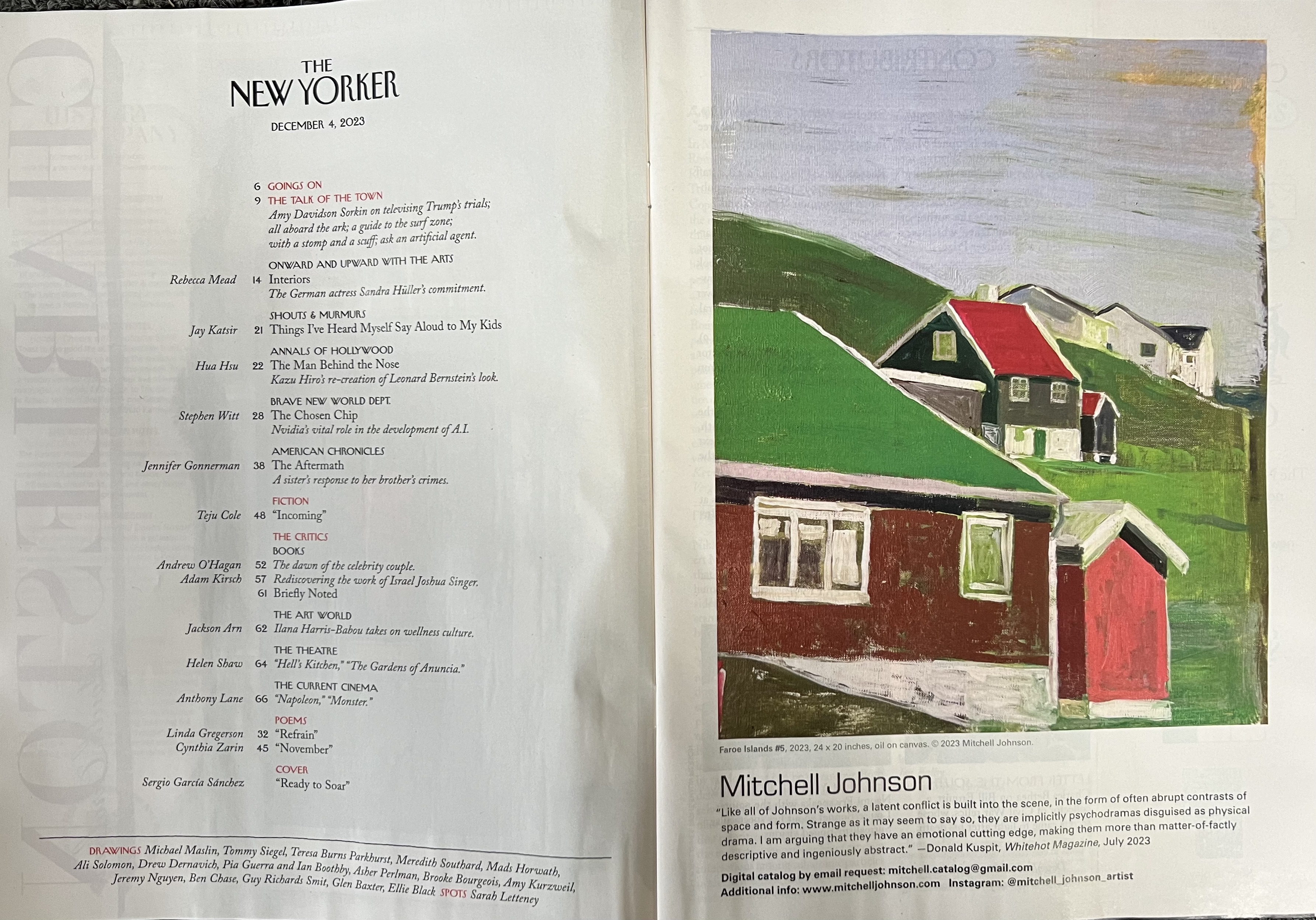
Mitchell Johnson Faroe Islands Painting in the December 4, 2023 New Yorker Magazine


Mitchell Johnson Reyjavik painting in the December 25, 2023 New Yorker Magazine


Mitchell Johnson Sinalunga Painting in the December 17, 2023 New York Times Magazine


Tuesday, January 9, 2024

"Luxembourg," 2022 appears in both the January 15, 2024 New Yorker Magazine and the February print issue of Artforum


"Luxembourg," 2022 16x16 inches oil/canvas

This painting, "Luxembourg," 2022, appears in both the January 15, 2024 issue of the New Yorker and the February issue of Artforum Magazine. If you click on the image above you'll see a higher quality photo that you can zoom in on to see the paint, the surface. This little kiosk in the Luxembourg garden has intrigued me for years but I only recently made a few paintings of it. When I first went to France in 1989 I was in Paris briefly and I would go for very long runs that often went through the Luxembourg and I'm pretty sure that's the first time I saw this kiosk. Like all of my paintings, this isn't so much a record of what was there as it is a jumping off point for some shapes and colors that I'm assembling that feel mysterious, baffling, complex. The chair could be any color, any location - whatever the painting needs. The way that the painting is built, the touch of the paint application are both very important and have evolved over 40 years. Each are impossible to consciously strategize or control. The painting may not work and it might get destroyed. Time will tell.

I talk about my painting process at length in various interviews. See Savvy Painter, Painting Perceptions, Huffington Post, I Like Your Work Podcast, Studio Break Podcast.

Donald Kuspit has written a lot about my work and you can read two of his essays at Whitehot Magazine.

There are two exhibits in 2024:

January-February, 2024
Selected Work 1988-2024
Flea Street Menlo Park

May 17-September 29, 2024
La révélation de Meyreuil, an exhibition of 50 small paintings
Musée de la Villa les Camélias in Cap d’Ail, France


Saturday, January 6, 2024

Mitchell Johnson Exhibit "La révélation de Meyreuil" at Musée de la Villa les Camélias, Cap d'Ail / May 17-September 29, 2024

 Save the date, May 17, 2024 is the opening of the retrospective exhibit, "La révélation de Meyreuil",

at Musée de la Villa les Camélias, Cap d'Ail, France. The exhibit runs May 17-September 29, 2024.

"In 1989, at the age of 25, Mitchell Johnson left New York for his first trip to Europe — a voyage that would launch a lifetime of interaction with color. Landing in Gotland, Sweden, and making his way south to Meyreuil, France, he was drawn to and overwhelmed by the new landscapes and unfamiliar colors and patterns. Driven by a powerful instinct to translate what he saw into paintings, he returned again and again to work on location and to study in museums."

"Meyreuil Fiat," 1989 6x12 inches oil/panel


You can read more about the exhibit in this review by Donad Kuspit at Whitehot Magazine

and also in this article at Hyperallergic.